
 Français
 Deutsch



AI is helping businesses optimize operations, reduce waste, and support various "green" solutions. But the paradox is that AI itself - especially large-scale models - consumes massive amounts of electricity, cooling water, and infrastructure.
Therefore, the question is no longer whether to use AI, but how to use it so that the benefits created outweigh the cost of resources consumed.
In other words: AI is only truly "green" when it is deployed the right way.
The AI Boom and the Paradox of a “Green Solution”
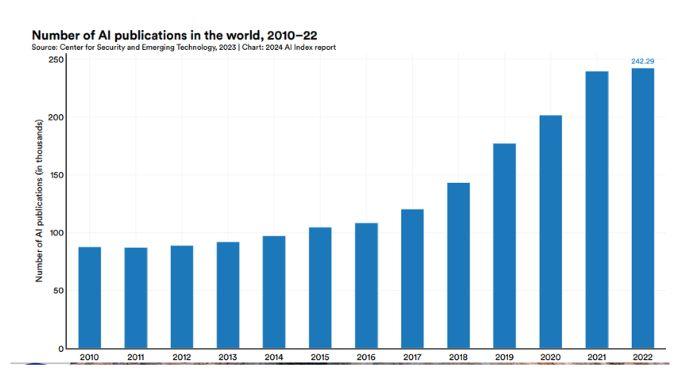
Over the past decade, AI has evolved at a breakneck pace, evident in both the scale of research and the level of global investment. According to the AI Index 2024 report (using data from the Center for Security and Emerging Technology – CSET, 2023), the number of English-language AI publications worldwide nearly tripled between 2010 and 2022, rising from approximately 88,000 to over 240,000. In 2022, the growth rate was about 1.1%, indicating a slowdown compared to the previous years of explosive expansion.
However, behind this robust growth lies a major sustainability paradox: AI is expected to be a tool for solving climate change, yet it is also a technology that consumes vast amounts of resources for training and operation. According to a renowned study from the University of Massachusetts, Amherst, and data re-analyzed by MIT Technology Review, training a single large-scale AI model can emit over 626,000 pounds of carbon dioxide equivalent - nearly five times the lifetime emissions of an average American car.
Therefore, the primary question is not “whether or not to use AI”, but how to apply AI in a way that creates positive value for the planet.
AI creates a clear advantage: Values that cannot be ignored
AI can contribute to sustainable development primarily through its ability to reduce waste and optimize resource use, helping us eliminate the inherent inefficiencies of traditional activities. Instead of operating based on guesswork, AI enables humans to perform "green" actions automatically and intelligently:
Firstly, AI acts as an "energy steward" by automatically adjusting lighting and air conditioning systems based on real-time occupancy and accurately forecasting demand to prevent power grids from running at excess capacity. In the transportation sector, AI directly cuts emissions by determining the shortest routes for delivery vehicles and predicting traffic congestion to avoid useless idling. Furthermore, AI helps reduce waste through "vision systems" that detect product defects right on the assembly line to minimize faulty goods, while also controlling robots to sort recyclables more accurately than humans. Most notably, AI eliminates the waste caused by "trial and error" by running virtual simulations, finding the most resource-efficient options right from the design phase without consuming chemicals or materials for physical experiments.
The Dark Side of the Glory: When AI is a Giant "Power Hungry" Machine
However, behind these optimization benefits lies a reality that few notice: AI is not as “virtual” as we might think. Every command or processing task operates on massive physical data centers, where millions of servers run 24/7. These systems “devour” a vast amount of electricity and require huge quantities of clean water to cool down the machinery, meaning every query you send consumes real-world resources rather than being free of charge.
Particularly in today's tech race, the smarter the models become, the higher the environmental price tag. Training a top-tier AI can emit as much carbon as hundreds of transcontinental flights, and this cost continues throughout the device's lifecycle - from component manufacturing to operation and replacement.
This is a notable psychological paradox: when AI makes everything faster and cheaper, humans tend to use it more than necessary. Previously, writing an article might take an entire day, whereas now it only takes a few minutes with AI; but instead of stopping at what is sufficient, we often keep requesting many more versions. Similarly, because generating images with AI is so easy, even a minor need can lead to dozens of trial generations. Therefore, while AI can help optimize individual processes, its very convenience can create a new resource burden if not used with control.
So, is AI “bad”?
Instead of viewing AI as a "savior" or a "villain," we need to see it for what it truly is: a tool that is not inherently "green" or "bad." The deciding factor lies in how humans design, deploy, and utilize this technology.
The value of AI is defined by its purpose. It becomes part of the solution when used to optimize operations, reduce waste, support healthcare, protect the environment, or solve social challenges. However, AI can also become part of the problem if misused to churn out low-value content, chase quantity over quality, or serve needs that offer no real value.
Therefore, what we need is not a "perfect" AI, but a smart and responsible way of using it. Only when we have clear goals, measurable efficiency, and a commitment to ethics and sustainability in its implementation can AI truly deliver benefits without increasing risks to society and the environment.
Sustainable AI: Responsibility from the Office to the Individual
For AI to be truly sustainable, responsibility lies not only with technology developers but also in the way it is used within businesses and in the habits of each individual.
For businesses, sustainable AI starts with choosing the right tool for the job, rather than deploying oversized models for simple tasks. This "just-enough" approach minimizes resource consumption while maintaining peak efficiency. Companies should also establish shared knowledge bases for reusable AI outputs - such as email templates, summaries, and standard procedures—to prevent multiple employees from repeating identical queries and driving up unnecessary computational costs. Additionally, training staff to write clear, targeted prompts from the outset is crucial; the fewer iterations required, the more time, money, and infrastructure resources are saved.
For individual users, sustainability begins with intentional usage. By crafting clear, informative, and goal-oriented prompts, users can get the right results on the first try, reducing redundant processing. At the same time, we should avoid overusing AI to generate excessive content just out of convenience or temporary curiosity, especially when it serves no practical purpose. In short, AI delivers its greatest sustainable value when used to solve real problems, rather than just adding to unnecessary digital consumption.
Conclusion
AI can be sustainable, but it won't happen by accident. If AI continues to evolve under the "bigger is better" mindset without oversight, the soaring costs of electricity, cooling water, and hardware resources risk turning AI into a new environmental burden. Therefore, for AI to be truly "green," we must proactively steer it toward energy efficiency and real-world value, rather than just chasing scale.
Achieving this requires a multi-dimensional approach: governments must establish policy frameworks and standards, while businesses must adopt AI responsibly with the ability to measure its impact. Simultaneously, scientists and engineers are developing technical solutions to make AI lighter and more efficient. When policy and technology go hand in hand, AI can finally become a core part of the climate solution, rather than a “resource devourer” of the digital age.